Recovery
How’s your nervous system?
Read straight from last night’s overnight HRV and resting heart rate versus your own baseline — responsive, opinionated, changes day to day. The strap-style read.
 NoBand

Whoop-grade recovery and Oura-style readiness — on the Apple Watch you already own. Overnight HRV, sleep, strain, and an AI coach that explains every number. Pay once. No subscription, ever.
Needs an Apple Watch · Your data stays in Apple Health
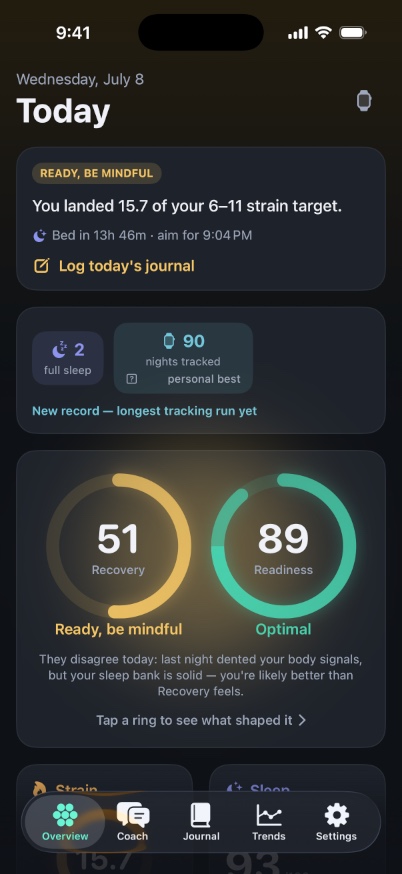
Read straight from last night’s overnight HRV and resting heart rate versus your own baseline — responsive, opinionated, changes day to day. The strap-style read.
Weighs sleep first — last night and your two-week balance — then a smoothed HRV trend, resting HR, temperature and load. The ring-style read.
When they disagree, that’s the insight — and NoBand tells you which one to trust.
Duration, bedtime consistency and interruptions — the same model your Apple Watch uses, tracked night to night.
A daily cardiovascular-load target set by your recovery. Know when to push and when to hold back.
Measured from real sleep — the sleeping-heart floor, not a daytime estimate — against your personal baseline.
Anchored on VO₂max — the strongest predictor of healthy aging — then adjusted for body composition and habits.
Ask why any number is what it is, or what to do about it. It answers from your data, in plain language.
Every score is transparent and shown with the exact inputs behind it. No black boxes, no invented numbers.
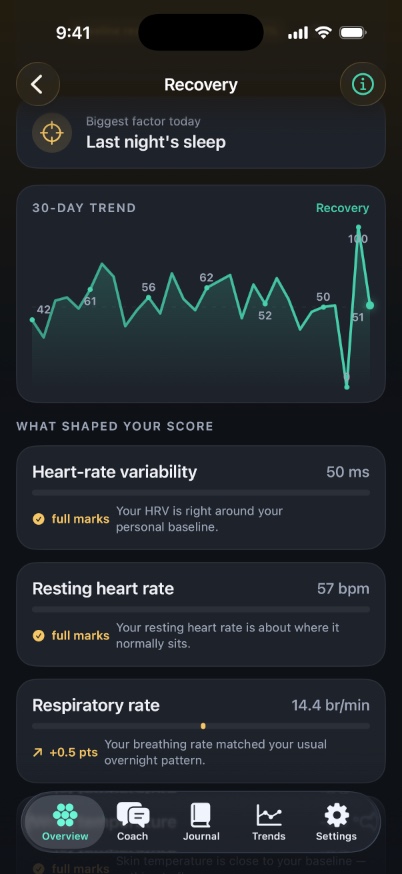
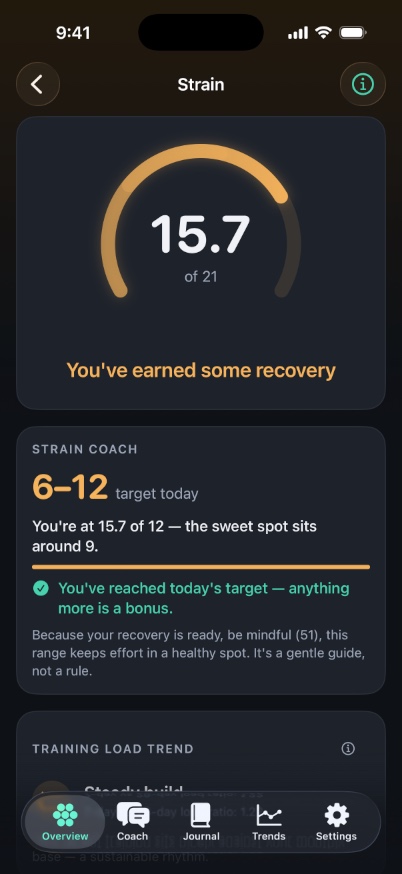
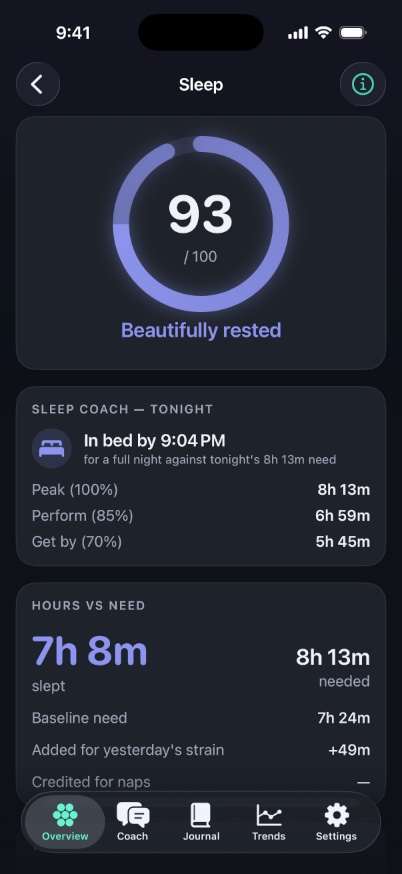
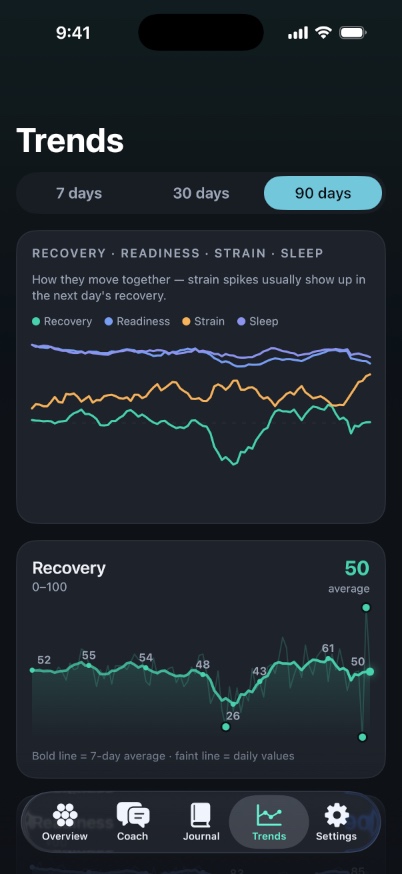
Every signal is compared with your own recent baseline, never a population average. A resting heart rate of 58 is excellent for one person and a warning sign for another.
Many wellness apps quietly bend scores toward flattering middles. We removed those curves. If your data says today is a 41, NoBand shows you 41.
Consumer sensors are noisy, and the first weeks read cautiously while your baseline fills in. NoBand publishes its limitations instead of hiding them.
Methods follow the ESC/NASPE standards for heart-rate variability (Circulation, 1996), HRV-guided training research by Plews, Laursen and Buchheit (Sports Medicine, 2013; Frontiers in Physiology, 2014), Borbély’s two-process model of sleep (1982), sleep-regularity findings from UK Biobank (Windred et al., 2024), and non-exercise VO₂max estimation (Jackson et al., 1990; Nes et al., HUNT, 2011).
WHOOP and Oura answer recovery and readiness well — and both charge you every month to keep reading your own numbers. NoBand asks the same questions using the Apple Watch already on your wrist.
| Comparison | NoBand | WHOOP | Oura |
|---|---|---|---|
| What you wear | The Apple Watch you own | A band, included | A ring, from $349 |
| Up-front | 49,99 zł, once | $0 with membership | $349–$499 |
| Every year, forever | Nothing | $199–$359 | $69.99 |
| Stop paying and… | Everything keeps working | The device stops | Scores are locked |
US list prices, checked August 2026. WHOOP is a trademark of WHOOP, Inc. Oura is a trademark of Ōura Health Oy. Apple, Apple Watch and Apple Health are trademarks of Apple Inc. NoBand is an independent app and is not affiliated with, endorsed by or sponsored by any of them.
Start with a free week — everything unlocked. Keep it with a single one-time purchase. No subscription, ever.
Your free week starts when your scores unlock — after about seven nights of wearing your watch to bed. Calibration doesn’t count against it.
Requires an Apple Watch. iPhone app.